Gain Staging
Definition
Gain staging is the setting of signal levels at each stage of an audio chain. Its aim is to keep as much signal as possible above the noise floor while leaving enough room that sudden peaks never reach the clipping point. The balance is set once, at the input, and then preserved through the rest of the chain.
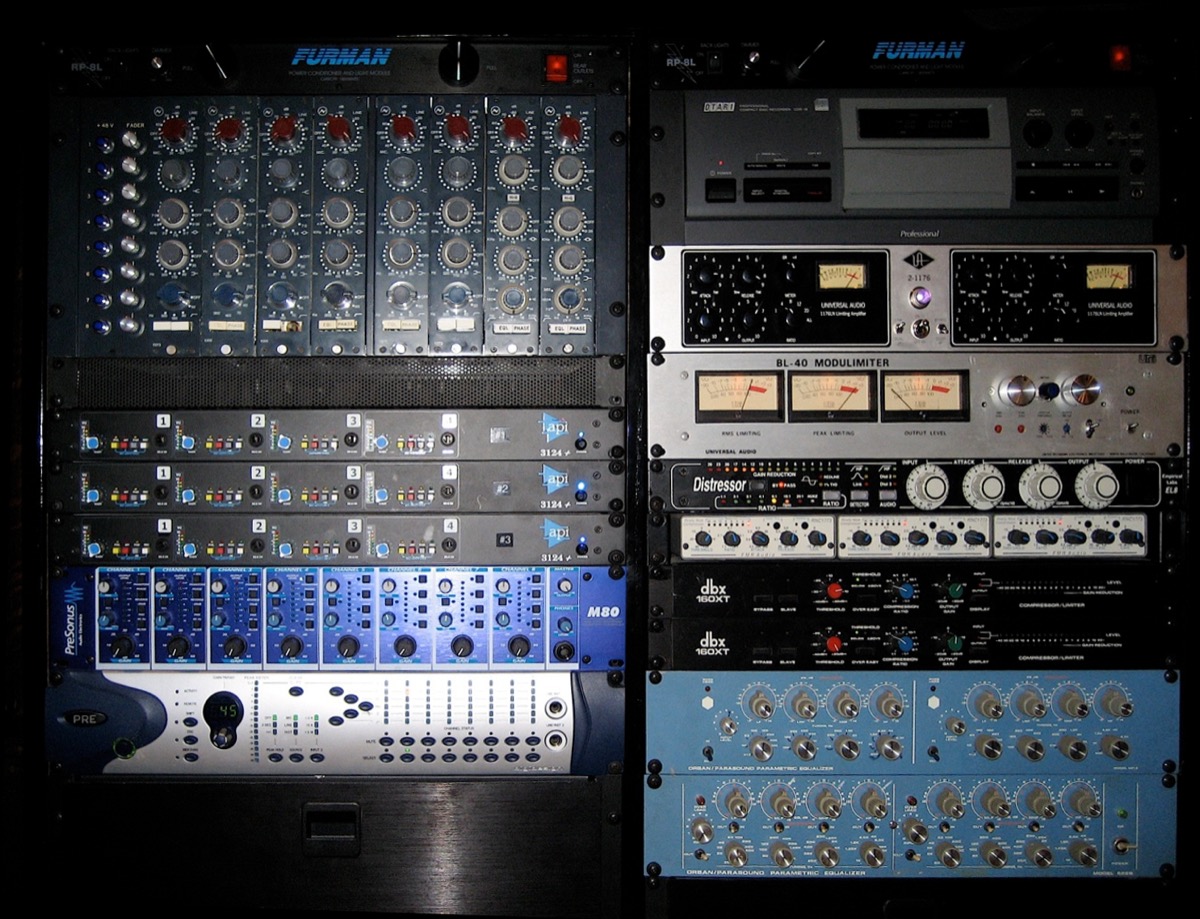

The guide
Analogue equipment is designed around a nominal operating level. Professional equipment runs at +4 dBu, about 1.23 volts, and consumer equipment at -10 dBV, about 0.32 volts. The difference of roughly 12 dB explains why a consumer output connected to a professional input sounds weak and noisy: the input receives far less level than it expects. Digital systems measure levels against 0 dBFS, the absolute clipping point of the converter as defined by AES17. To leave room for peaks, broadcast practice aligns nominal level well below it. The EBU R68 recommendation maps the analogue alignment level of 0 dBu to -18 dBFS, while SMPTE recommended practice RP155 maps +4 dBu to -20 dBFS, leaving 6 dB more headroom. In live sound, a similar target is common practice rather than a standard. The gap between nominal level and zero is the headroom, which absorbs sudden peaks such as a drummer playing harder.
The two failure modes sit at opposite ends. With too little gain, the noise floor is raised along with the signal and everything hisses. With too much gain, the signal clips, and a clipped digital peak cannot be recovered by any later fader. The usual practice is to set the input trim so that the average level of normal programme material sits around -18 dBFS, with peaks well short of zero, then to run every later stage at approximately unity gain so that the level set at the input is preserved.
The rule
Gain is set once at the source, and later stages run at unity instead of compensating for it.
Glossary terms
Sources
- EBU R68-2000 : niveau d'alignement numérique −18 dBFS (≙ 0 dBu) · tech.ebu.ch
- SMPTE RP 155:2014, niveaux de référence : −20 dBFS ≙ +4 dBu (0 VU) · ieeexplore.ieee.org
- AES17 (révision 2020) : définition du 0 dB FS (sinusoïde pleine échelle) · aes.org
- Sengpielaudio, conversions : +4 dBu = 1,228 V, −10 dBV = 0,316 V, écart 11,8 dB · sengpielaudio.com
- Yamaha Pro Audio : gain staging en console live · hub.yamaha.com