HDMI, SDI, and DisplayPort
Definition
Digital video can travel over several transports, and each balances convenience against reliability differently. The cable is therefore chosen according to what the job cannot afford to lose, not only according to the socket available.

The guide
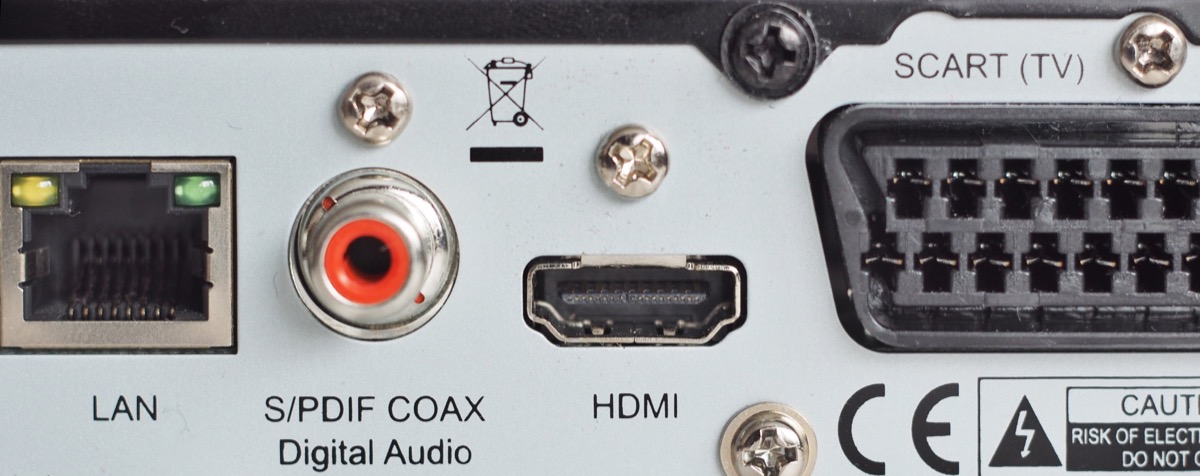
HDMI is found on almost all consumer equipment, laptops and presentation systems, and is simple to use in everyday situations. In a live installation it is the least robust of the three. Each connection starts with a handshake in which the devices exchange EDID information and often HDCP encryption keys. The standard Type A connector does not lock, so a cable can be pulled out by accident. The HDMI specification sets no maximum cable length, but manufacturers report that passive cable runs become unreliable beyond roughly 5 to 15 metres depending on the resolution. HDMI suits a lectern laptop but is a risk for any signal the show depends on. SDI follows the opposite approach. Designed for broadcast, it runs over 75-ohm coaxial cable with locking BNC connectors and carries video reliably over long distances, of the order of 100 metres in HD depending on the cable. Its data rates are standardised and predictable: about 1.485 Gbps for HD-SDI (SMPTE ST 292) and about 2.97 Gbps for 3G-SDI (ST 424) at 1080p60, with 6G (ST 2081) and 12G (ST 2082) variants for 4K. Because it locks in place and tolerates long runs, critical signal paths are usually built on it. SDI does not carry HDCP, so an HDCP-protected source generally cannot be output over SDI.
DisplayPort is the third option. It offers very high bandwidth and is commonly used to drive high-resolution computer displays, and it is a common input on LED-wall processors alongside HDMI and SDI. Like HDMI, it negotiates EDID and HDCP, and its connectors often carry an optional latch. It belongs mainly to the computing world rather than to live signal distribution. The transport is therefore matched to the consequences of a failure: SDI where a dropout would be unacceptable, HDMI where convenience matters more and a backup is ready.
The rule
Critical signal paths are carried over SDI, with HDMI kept for non-critical sources.
Glossary terms
Sources
- SMPTE ST 292-1 : HD-SDI 1,485 Gb/s sur coaxial 75 Ω · en.wikipedia.org
- SMPTE ST 424:2012 : 3G-SDI 2,970 Gb/s (1080p50/60) · reference.globalspec.com
- SMPTE OV 2082-0 / ST 2081 / ST 2082 : 6G (5,94 Gb/s) et 12G-SDI (11,88 Gb/s) · pub.smpte.org
- HDMI Licensing Administrator : pas de longueur maximale fixée ; au-delà de quelques mètres en 48 Gb/s, câbles actifs · hdmi.org
- Digital Content Protection LLC : HDCP, négocié lors du handshake HDMI et DisplayPort · digital-cp.com
- Amphenol : connecteur HDMI Type E verrouillable (le Type A ne se verrouille pas) · amphenol-cs.com