Electrical Safety
Definition
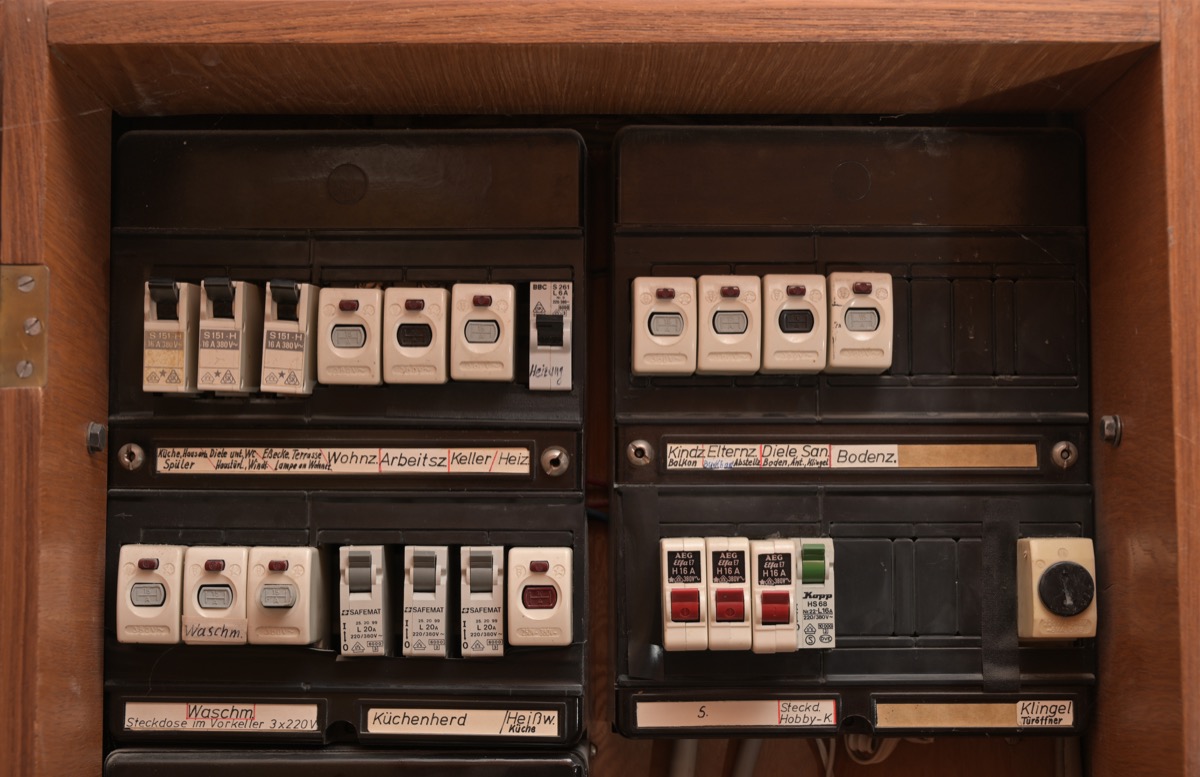
Electricity on a show carries three risks at once: electric shock to people, fire from overheating, and damage to equipment. The defences against them are layered, each covering a different failure. Overcurrent protection, provided by circuit breakers and fuses, is sized to protect the cable: it disconnects the circuit before the conductor can overheat, a principle IEC 60364-4-43 expresses as Ib ≤ In ≤ Iz. Nuisance tripping is therefore never solved by fitting a larger breaker, which would remove the protection the cable depends on. Earthing, or grounding, gives fault current a path back to the source. In TN systems, common in the United Kingdom and on many industrial networks, the fault current is high enough to trip the breaker; in TT systems, the standard for low-voltage public supply in France, it is the residual current device that disconnects the supply. Residual current protection detects current leaking to earth and cuts the supply within a few tens of milliseconds at typical shock currents. Its thresholds differ by region. IEC practice, where the device is called an RCD (DDR in France), uses devices of 30 mA or less under IEC 61008 and IEC 61009, while the North American GFCI (UL 943, Class A) trips at around 4 to 6 mA. This protection is essential near water, outdoors and wherever performers are in direct contact with equipment. Temporary installations for shows are covered by IEC 60364-7-711 (part 7-711 of NF C 15-100 in France, BS 7909 in the United Kingdom) and, in the United States, by NEC Articles 520, 525 and 590.

The guide
Load management starts with arithmetic. The connected load is kept well below the rating of the circuit, with a margin for inrush current when equipment switches on and for the extra fixture that is often added later. In North America, the NEC limits a continuous load, meaning one that lasts 3 hours or more, to 80 percent of the circuit rating. IEC 60364, NF C 15-100 and BS 7671 set no such percentage and size circuits with correction factors for temperature and grouping, but keeping a similar margin is common practice everywhere.
Connections must be secure and rated for the current they carry. A loose or undersized connection is one of the most common sources of heat and failure on a rig, and neither the breaker nor the residual current device detects it. When there is any doubt about a power question, work stops until the situation has been verified, because electrical faults cause harm immediately and without warning.
The rule
When there is doubt about power, work stops until it has been verified.
Glossary terms
Sources
- IEC 60364-4-43 (HD 60364-4-43), la protection contre les surintensités protège le conducteur : Ib ≤ In ≤ Iz, I2 ≤ 1,45 Iz · webstore.ansi.org
- IEC 60364-4-41 / BS 7671 reg. 411.3.3 : DDR ≤ 30 mA sur les prises ≤ 32 A · electrical.theiet.org
- Schneider Electric, Guide de l'installation électrique : schéma TT et protection différentielle 30 mA (NF C 15-100) · fr.electrical-installation.org
- IEC 61008 / 61009 : temps de coupure DDR ≤ 300 ms à IΔn, ≤ 40 ms à 5 IΔn · electrical.theiet.org
- IEC 60364-7-711:2018 (NF C 15-100 partie 7-711 ; BS 7909 au Royaume-Uni) : installations temporaires d'expositions et de spectacles · webstore.iec.ch
- NFPA 70 (NEC) 210.20(A) et Art. 100, charge continue ≥ 3 h, 125 %, soit 80 % (règle nord-américaine) ; GFCI : NEC 590.6, OSHA 29 CFR 1926.404(b)(1) · osha.gov