Amplification and Speakers
Definition
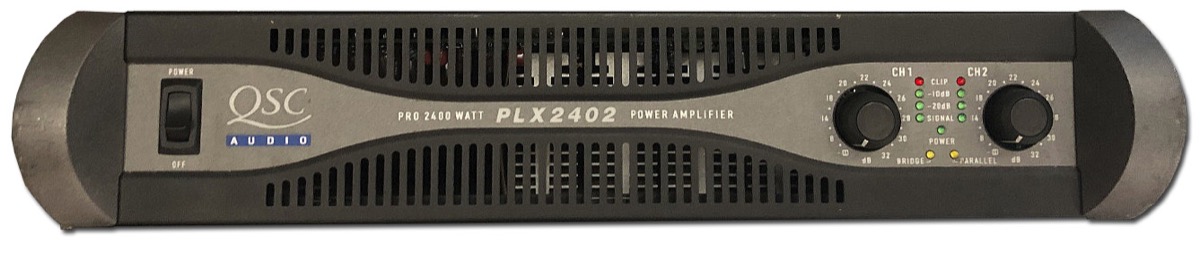
The amplifier and the loudspeaker are the last two links of the chain. The amplifier raises the signal to the power the loudspeaker needs, and the loudspeaker converts that power into sound. In a passive system, separate amplifier racks feed the cabinets. In an active (powered) system, amplification and processing are built into the cabinet and matched by the manufacturer.

The guide
Two values govern the match between amplifier and loudspeaker. The first is impedance, the electrical load presented by the loudspeaker, usually 8 ohms and sometimes 4 or 16. Two 8-ohm cabinets wired in parallel present a combined load of 4 ohms; at a given voltage the amplifier must then deliver roughly twice the current, and it must be rated for that load. The second value is sensitivity, the SPL a cabinet produces from one watt, measured at one metre. Each +3 dB represents a doubling of power, so a 96 dB cabinet needs half the power of a 93 dB cabinet to reach the same level.
Headroom refers to the amplifier power available for peaks. QSC recommends an amplifier rated at least twice the continuous power rating of the loudspeaker, and Crown recommends two to four times, which leaves 3 to 6 dB of headroom for peaks. When an amplifier clips, the flattened waveform delivers more average power to the loudspeaker than an unclipped signal of the same peak level. Rod Elliott (Elliott Sound Products) identifies this excess average power, more than the added harmonics, as the usual cause of tweeter failure. A large amplifier driven too hard produces the same excess, so the protection of a loudspeaker depends on the average power it receives and on an amplifier used within its clean range.
The rule
Loudspeakers are protected by an amplifier sized to their rating and kept out of clipping, since excess average power is what damages drivers.
Glossary terms
Sources
- QSC, Which power amplifier is best for my loudspeakers? Amplificateur d'au moins deux fois la puissance continue de l'enceinte, ou égal à sa puissance programme · support.qscaudio.com
- Crown Audio, How Much Amplifier Power Do I Need? 2 à 4 fois la puissance continue, soit 3 à 6 dB de réserve · crownaudio.com
- R. Elliott, Why Do Tweeters Blow When Amplifiers Distort? (ESP) : les harmoniques de l'écrêtage sont rarement la cause de la destruction des tweeters · sound-au.com
- R. Elliott, Power Amplifier Clipping (ESP) : l'écrêtage augmente la puissance moyenne délivrée · sound-au.com
- QSC, How to Understand All Those Loudspeaker Specs : sensibilité en dB SPL à 1 W et 1 m, impédance nominale · blogs.qsc.com