Fiber Optics
Definition
Optical fibre carries data as pulses of light instead of electrical signals on copper. It is immune to electromagnetic interference, and it reaches far beyond the roughly 100-metre limit of twisted-pair Ethernet. A fibre run past dimmers, motors or power cables does not pick up the hum and noise that a copper run on the same route can collect.
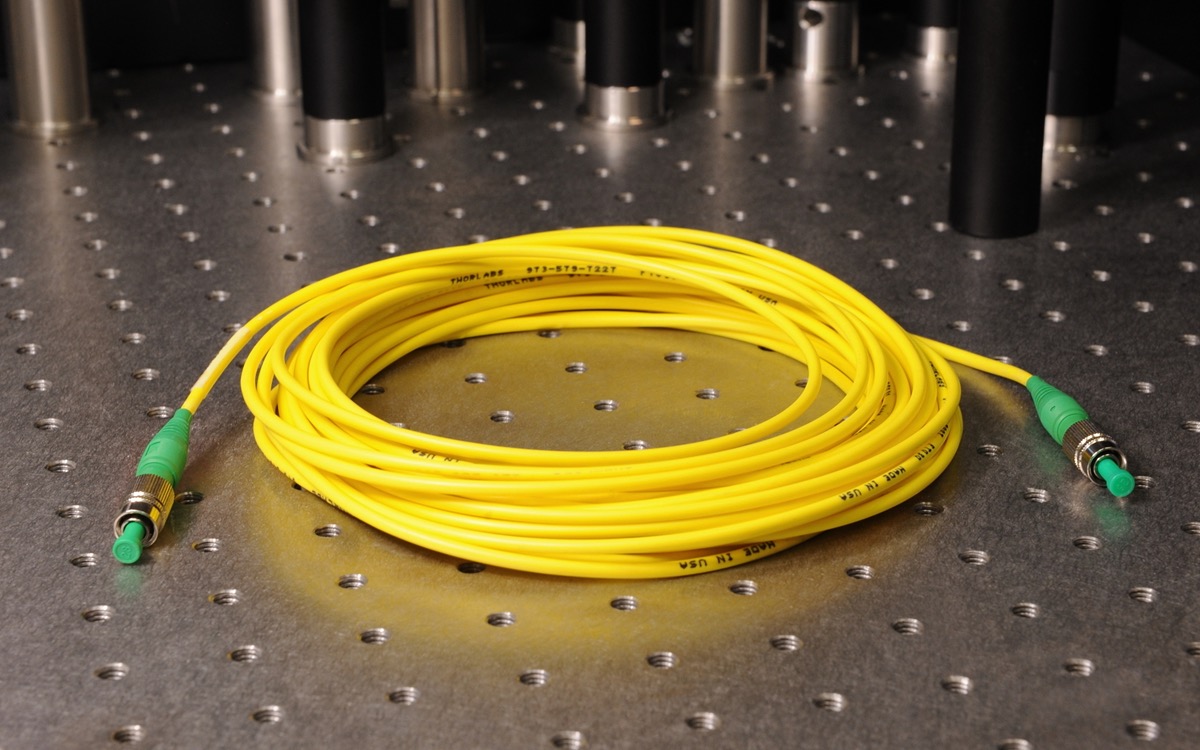

The guide
The main choice is between singlemode and multimode fibre. Singlemode fibre has a very small core, is used with laser sources at 1310 or 1550 nanometres and reaches kilometres, which suits long runs between buildings or across a stadium. Multimode fibre has a larger core and uses cheaper 850-nanometre sources; with 10GBASE-SR optics (IEEE 802.3ae), OM3 fibre reaches 300 m at 10 gigabit, and OM4 fibre reaches 400 m since IEEE 802.3-2012, which covers typical distances inside a venue. The fibre type is chosen from the distance and the data rate, and the two types are not interchangeable: a singlemode transceiver does not communicate with a multimode one.
Connectors and transceivers are matched to the fibre type as well. In racks, the small LC connector is the standard on SFP and SFP+ transceivers and on switches. Touring systems use ruggedised connectors such as Neutrik opticalCON. Broadcast cameras use the SMPTE hybrid system, in which the SMPTE 304M connector and 311M cable combine two singlemode fibres with copper conductors for camera power.
The polish of the end face is a second compatibility rule. An APC connector (green body under the TIA-598 colour code, end face angled at 8 degrees) is not mated with a UPC connector (blue body). The two plug together physically, but the angle leaves an air gap that causes high loss and strong reflection and can damage both end faces. Contamination of the end face is a frequent cause of fibre faults. IEC 61300-3-35 defines how end faces are inspected and graded, and test-equipment makers such as Fluke Networks recommend inspecting every end face before mating and cleaning the ones that fail inspection.
The rule
Long runs, and runs through electrically noisy areas, are made on fibre.
Glossary terms
Sources
- IEEE 802.3ae / 10GBASE-SR : 850 nm, 300 m sur OM3 (pointeur Wikipédia) · en.wikipedia.org
- Traverso et Tosetti (Cisco), IEEE 802.3 maintenance, Defining 10GBASE-S over OM4 media : proposition de la portée de 400 m sur OM4 · ieee802.org
- Ethernet Alliance, 10GbE Standardized to 400 Meters on OM4 Fiber : 400 m sur OM4 intégrés à IEEE 802.3-2012 · ethernetalliance.org
- Siemon, No More Guesswork: The Truth About Extended Reach Network Cabling Solutions : canal cuivre à paires torsadées limité à 100 m selon TIA-568 · siemon.com
- FOA, Understanding Wavelengths In Fiber Optics : multimode à 850 nm, monomode à 1310 et 1550 nm · thefoa.org
- Fluke Networks, What is an APC connector : APC vert à 8°, UPC bleu, accouplement APC/UPC à proscrire (perte, dommages) · flukenetworks.com
- Fluke Networks, Easier fiber end face inspections: changes to IEC 61300-3-35 : inspection et classement des faces, inspecter avant connexion, nettoyer en cas d'échec · flukenetworks.com
- FOA, Fiber Optic Cable Color Codes : code couleur TIA-598, connecteur APC vert · thefoa.org
- Fluke Networks, Fiber Contamination, Cleaning and Inspection : la contamination comme cause de pannes, inspection de chaque face avant connexion · flukenetworks.com
- Neutrik, opticalCON DUO : connecteur LC duplex dans un boîtier métallique renforcé pour la tournée · neutrik.com
- Prysmian, SMPTE 311M HD hybrid camera cable : câble hybride (deux fibres monomodes et conducteurs cuivre) · prysmian.com
- LEMO, 3K.93C.Y SMPTE Hybrid : connecteur hybride fibre et cuivre caméra-CCU (SMPTE 304M) · lemo.com