Switchers and Scalers
Definition
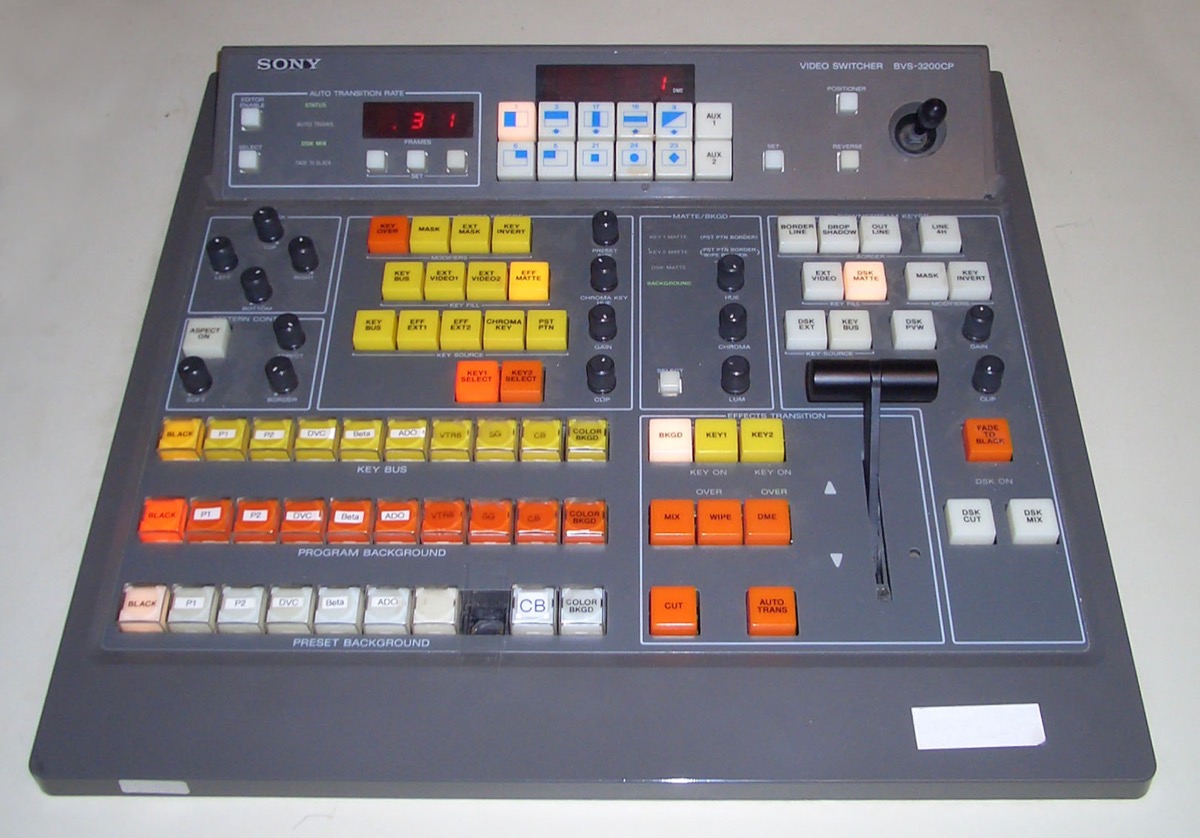
A switcher and a scaler perform two separate functions. The switcher selects which source reaches the output. The scaler converts each incoming source to one common output format, so that a cut between sources does not change the format received by the display. Without scaling, a cut from a laptop at 1080p60 to a camera at 1080i50 changes both the scan type and the frame rate, and the display usually shows black frames or glitches while it relocks to the new signal.

The guide
A common format is necessary for a clean transition but does not guarantee one. For a cut or a dissolve without disturbance, the inputs also have to be frame-synchronised, which means that their frames start at the same instant. Two methods provide this. With genlock, a common reference signal (black burst or tri-level sync) is distributed to every source, so that all of them lock to the same timing. A frame synchroniser, often built into the switcher's inputs, buffers each input and re-times it to the switcher's reference, at the cost of added delay. Inputs that share both format and timing can be cut or mixed without visible disturbance.
The signal path follows a fixed order: input, scaling, switching, output. Reports that a switcher is unstable usually trace back to an input that does not match the system format or has not been synchronised.
The rule
Every input is converted to the system format and synchronised before it reaches the switcher.
Glossary terms
Sources
- Genlock (Wikipédia, pointeur secondaire) : verrouillage des sources sur un signal de référence commun · en.wikipedia.org
- Black and burst (Wikipédia, pointeur secondaire) : signal de référence des installations SD et analogiques · en.wikipedia.org
- Tri-level sync (Wikipédia, pointeur secondaire) : référence de synchronisation des formats HD · en.wikipedia.org
- Video scaler (Wikipédia, pointeur secondaire) : conversion d'une source vers la résolution de sortie · en.wikipedia.org