Camera Operation
Definition
Live camera operation rests on the control of exposure, focus and framing. Exposure results from three settings, often called the exposure triangle. The aperture (iris) sets how much light reaches the sensor and also the depth of field. The shutter speed sets how much motion blur each frame records. ISO or gain sets the sensitivity of the sensor, and raising it adds noise. Clipped highlights contain no information that can be recovered, whereas underexposed shadows can be lifted slightly in post-production at the cost of noise, so the usual practice is to expose to protect the highlights.

The guide
The 180-degree shutter rule sets the shutter speed at about the inverse of twice the frame rate, 1/50 second at 25 fps and 1/60 at 30 fps, for motion blur that looks natural. Faster shutter speeds make movement look more staccato. The shutter also changes how the camera records the flicker of LED sources and discharge lamps, so it belongs to the anti-flicker setup as well as to exposure.
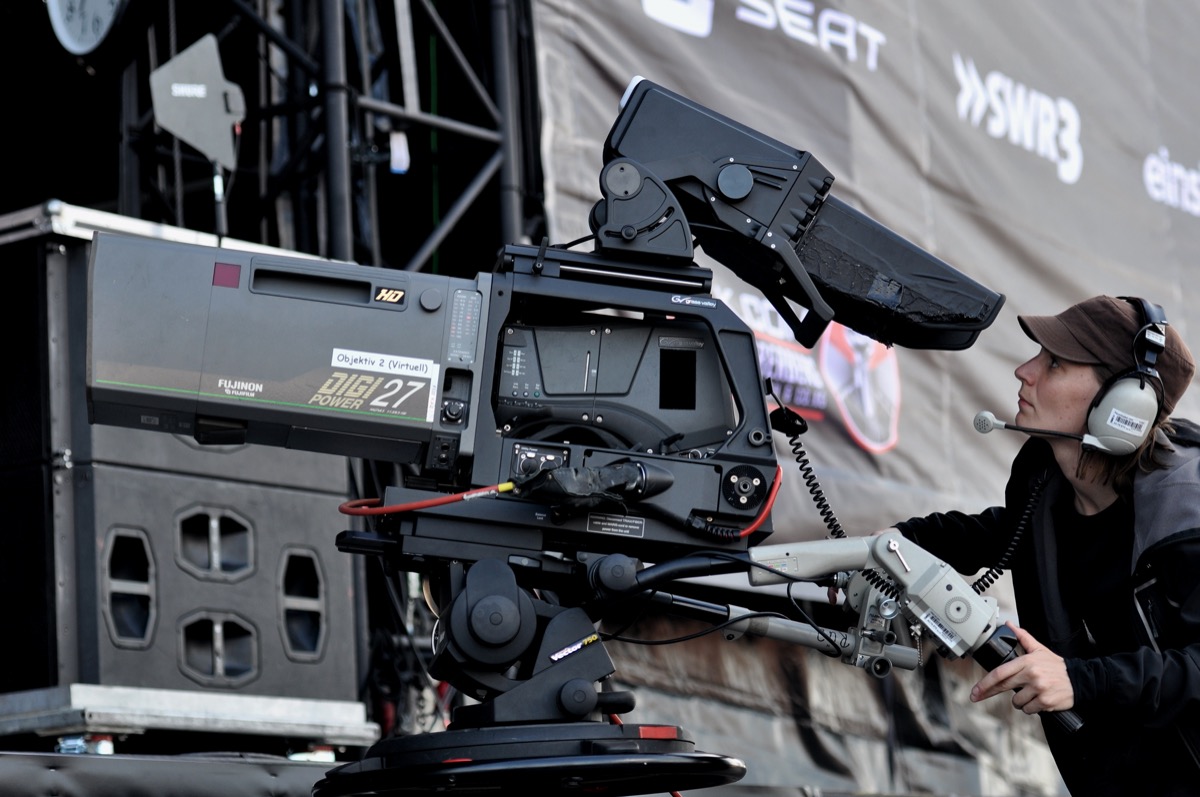
Focus has to hold on moving subjects, and framing has to stay consistent from shot to shot so that the cameras cut together. In live production, iris, focus and white balance are usually controlled manually. Auto-iris hunts when the scene changes, autofocus can shift to the wrong subject and auto white balance can change the colour during the show. Operators therefore lock these settings and adjust them by hand, because the picture has to behave predictably when it is on air.
The rule
Exposure is set to protect the highlights, because clipped white cannot be recovered.
Glossary terms
Sources
- StudioBinder, règle des 180 degrés : vitesse d'obturation ≈ 1/(2 × cadence) · studiobinder.com
- RedShark News : règle des 180 degrés et cas où l'on s'en écarte · redsharknews.com
- Exposure (photography) (Wikipédia, pointeur secondaire) : exposition déterminée par le temps de pose et l'ouverture · en.wikipedia.org
- Cambridge in Colour, exposition : ouverture et profondeur de champ, vitesse et flou de bougé, ISO et bruit · cambridgeincolour.com