Effects and Space
Definition
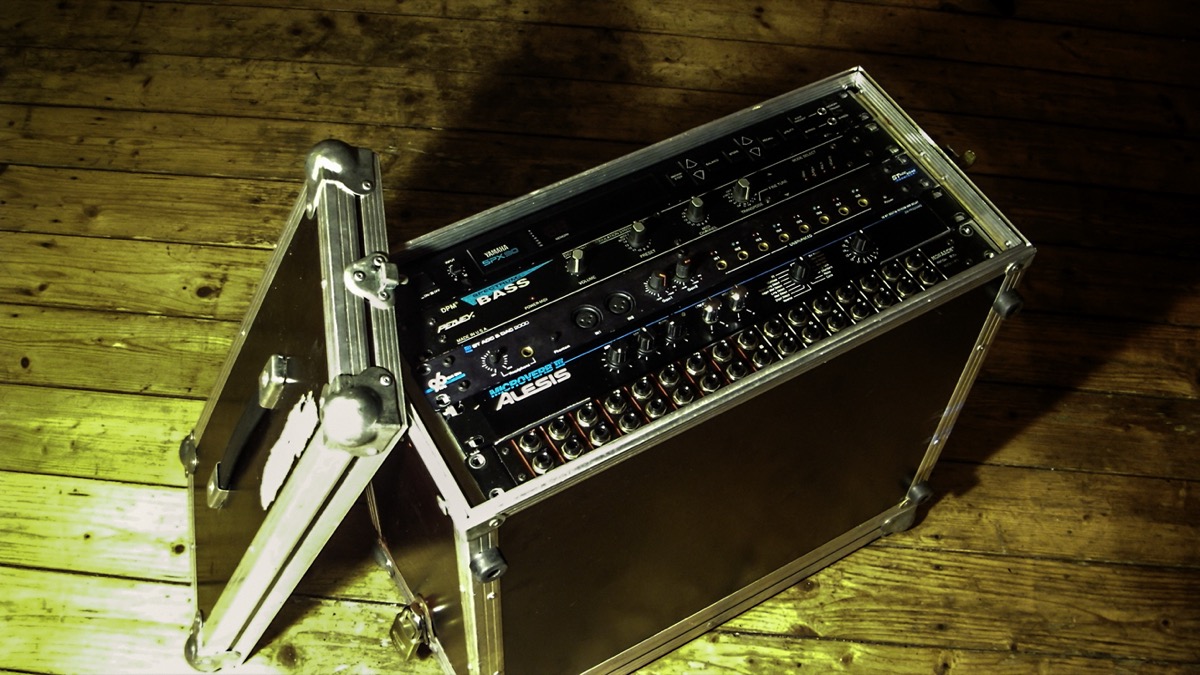
Effects create a sense of space and depth around sources that are close-miked and therefore dry. Reverberation simulates the sound of a physical space. Its decay time, often written RT60, is the time the sound takes to decay by 60 dB, a quantity whose measurement is standardised in ISO 3382; a short decay suggests a small room and a long decay a large hall or a cathedral. Pre-delay is the short gap before the reverb tail begins, and it keeps the dry source distinct and in front of its own reverberation.

The guide
A delay produces distinct, repeated echoes, usually set to the tempo of the music. A quarter note lasts 60,000 divided by the tempo in beats per minute, in milliseconds, so a song at 120 BPM gives a quarter note of 500 ms and an eighth note of 250 ms. Repeats set to these values fall in time with the music. Modulation effects such as chorus and flanger mix the signal with a copy whose pitch or delay varies slightly, which adds width and movement.
These processes depend on contrast between dry and wet signals and between near and distant sources. A vocal that is mostly dry with a little plate reverb sounds present and close, while a guitar placed in a long hall reverb sounds further back. Adding effects to every source removes that contrast and reduces intelligibility. Effects that sound impressive in solo often mask the words in the full mix, so their level is judged with the whole mix playing.
The rule
An effect that is clearly noticeable as a separate element in the mix is set too loud.
Glossary terms
Sources
- ISO 3382-1:2009 / 3382-2:2008 : mesure du temps de réverbération (décroissance de 60 dB, extrapolée de 20 ou 30 dB) · nti-audio.com
- Wikipedia, Reverberation (pointeur secondaire) : définition du RT60 · en.wikipedia.org
- Sengpielaudio, conversion tempo/délai : noire en ms = 60 000 / BPM ; croche = moitié · sengpielaudio.com